Mod 1 and Mod 2 motorcycle test guide
Getting ready for your full motorcycle licence? This guide explains what happens on the DVSA Module 1 (off-road) and Module 2 (on-road) tests, shows the official Module 1 manoeuvring area layout, links to DVSA’s own test videos and lists every “show me, tell me” safety question with the official answers. For courses, prices and dates, see our full motorcycle licence (DAS) page.
Module 1: the off-road manoeuvring area
You take the Module 1 test in an off-road motorcycle manoeuvring area at a DVSA test centre. The test normally takes about 20 minutes and includes:
- Wheeling the moped or motorcycle and using the stand
- Riding a slalom and figure of 8
- A slow ride
- A U-turn
- Cornering and a controlled stop
- Cornering and an emergency stop
- Cornering and hazard avoidance
For the hazard avoidance and emergency stop exercises you must ride at a minimum speed of 19mph on a moped and 31mph on a motorcycle (50km/h), checked with speed-measuring equipment.
You’ll be told at the end of the test whether you’ve passed. You pass Module 1 with no serious or dangerous faults (sometimes called ‘majors’) and no more than 5 riding faults (‘minors’). Take your pass certificate to your Module 2 test.
The manoeuvring area layout
The layout depends on the test centre. At multi-purpose test centres there is a left-hand and a right-hand circuit, and the examiner can use either. The numbers on the DVSA diagrams below follow the order of the exercises: stands and manual handling, slalom, figure of eight, slow ride, U-turn, cornering, controlled stop, the circuit rides, the emergency brake and the avoidance exercise.
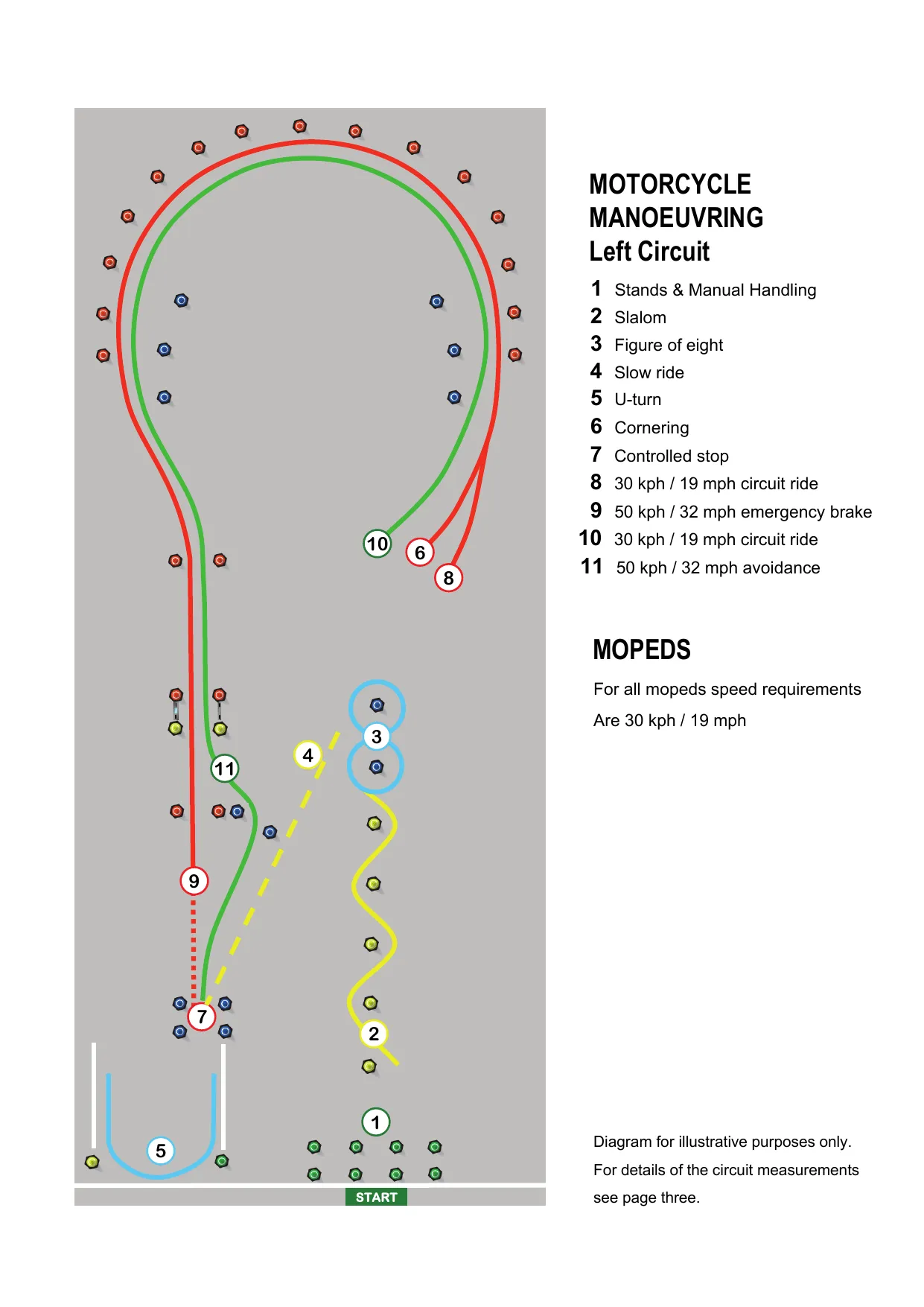
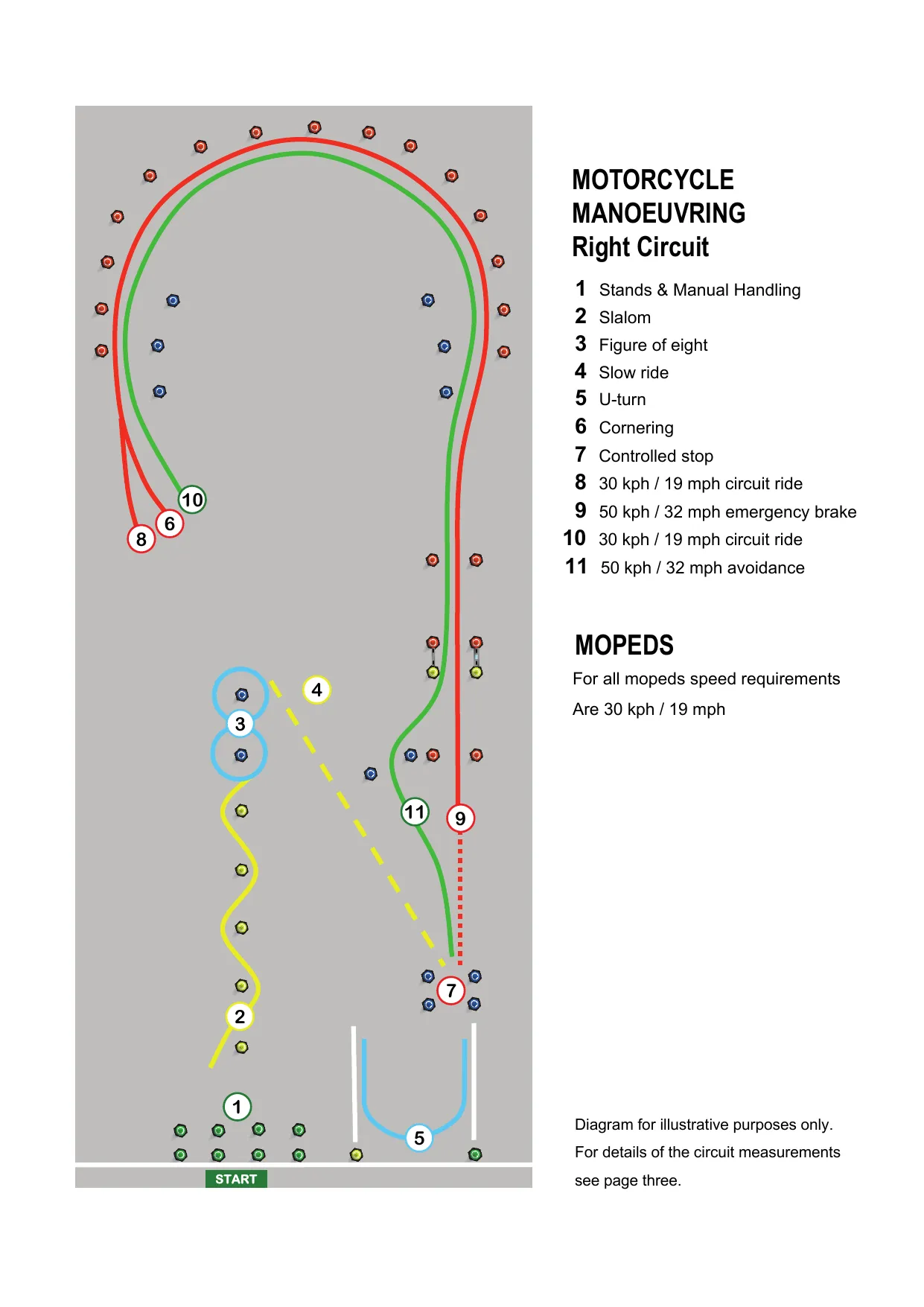
Diagrams: Driver and Vehicle Standards Agency, motorcycle manoeuvring area diagrams. Contains public sector information licensed under the Open Government Licence v3.0.
How we prepare you for Module 1
Your first full licence session with us is Module 1 training. You practise the Module 1 exercises off-road at Edventure Rider West Thurrock, Chingford or Hatfield. You need at least 3 training sessions before your Module 1 test: Module 1 training, Module 2 training and one more of your choice. If you find Module 1 challenging, we recommend an extra Module 1 session as your third. We book your tests for you at the DVSA test centres we use: Enfield, Basildon, Erith and Gillingham.
Watch the official DVSA test videos
DVSA has published official videos showing exactly what happens on each part of the motorcycle test. Watch them before your training sessions and again before your test.
Module 1 (off-road) test
Module 2 (on-road) test
Module 2: the on-road test
You must pass Module 1 before you can take Module 2. The Module 2 test normally takes about 40 minutes and includes:
- an eyesight check: reading a number plate from 20 metres (20.5 metres for an old-style plate)
- 2 ‘show me, tell me’ vehicle safety questions
- road riding, including normal stops, an angle start and a hill start (where possible)
- about 10 minutes of independent riding, without sat nav
The examiner gives you directions by radio and normally follows you on a motorcycle. You pass Module 2 with no serious or dangerous faults and no more than 10 riding faults, and you can ride without L plates straight away. Bring your Module 1 pass certificate and all the documents you took to Module 1.
‘Show me, tell me’ questions for the motorcycle test
At the start of your Module 2 test the examiner will ask you 2 of these vehicle safety questions. They test that you know how to carry out basic safety checks on your bike. These are all the questions you could be asked, with the answers DVSA expects, as published on GOV.UK.
1. Identify where you would check the engine oil level and tell me how you would check that the engine has sufficient oil.
Identify where to check level, i.e. dipstick or sight glass. Explain that level should be between max and min marks. For dipstick remove dipstick and wipe clean, return and remove again to check oil level against max/min marks. For sight glass, ensure glass is clean when checking.
2. Show me how you would check that the horn is working on this machine (off road only).
Check is carried out by using control (turn on ignition if necessary).
3. Identify where the brake fluid reservoir is and tell me how you would check that you have a safe level of hydraulic fluid.
Identify reservoir, check level against high/low markings.
4. Tell me how you would check that the lights and reflectors are clean and working.
Explanation only: Operate switch (turn on ignition if necessary), identify reflectors. Check visually for cleanliness and operation.
5. Show me how you would check that the brake lights are working.
Operate brake, place hand over light or make use of reflections in windows, garage doors etc, or ask someone to help.
6. Tell me how you would check the condition of the chain on this machine.
Check for chain wear, correct tension and rear wheel alignment. Tension should be adjusted as specified in the machine handbook. Drive chain should be lubricated to ensure that excessive wear does not take place.
7. Show me what checks you would make on the steering movement before using the machine.
Handlebars should be free to move smoothly from full left lock to full right lock without any control cables being stretched, trapped or pinched and without any snagging between moving and fixed parts.
8. Tell me how you would check your tyres to ensure that they are correctly inflated, have sufficient tread depth and that their general condition is safe to use on the road.
Correct tyre pressure settings can be found in the owner’s manual. Pressures should be checked using a reliable gauge. Tread depth must be at least 1mm deep, forming a continuous band at least 3/4 of the breadth of the tread and all the way around. There should be no lumps, bulges or tears.
9. Show me how you would check the operation of the front brake on this machine.
Wheel the machine forward and apply the front brake.
10. Show me how you would check the operation of the brakes on this machine.
Check for excessive travel on the brake lever and the brake pedal and for unusual play or sponginess.
11. Show me how you would check the operation of the engine cut out switch.
Operate switch, without the engine being started.
12. Show me how you would switch on the rear fog light and explain when you would use it (if fitted).
Operate switch (turn on ignition and dipped headlights if necessary). Check warning light is on. Explain use.
13. Show me how you switch your headlight from dipped to main beam.
Operate switch (with ignition or engine on if necessary), check with main beam warning light.
The pillion (balance) question
The examiner will also ask you one straightforward question about carrying a pillion passenger. DVSA’s examiner guidance gives these examples:
- What problems could arise from carrying a pillion passenger?
- How should a passenger be carried on the pillion seat?
- How would the balance of the machine be affected if you carried a pillion passenger?
If you answer one or more of the questions incorrectly, you get one riding fault. We go through all the questions with you during your Module 2 training.
Pillion questions
The examiner asks only one pillion question, so you won’t get all of these. The questions and answers below are Edventure Rider’s own tips to help you prepare, not official DVSA wording.
What advice would you give a pillion?
- They should wear appropriate clothing.
- They must only get on or off the motorcycle when told to do so.
- They must keep their feet on the footrests.
- They must hold on to the rider, and try to relax.
- They should refrain from hand signals.
How will carrying a pillion affect the handling of the motorcycle?
- The bike will be less stable at low speeds.
- The steering will become lighter, especially while accelerating.
- It will take longer to stop and accelerate.
What adjustments on the motorcycle are needed before carrying a pillion?
- Headlights, footrests, mirrors, suspension, tyre pressures.
What will happen if you brake or accelerate hard while carrying a pillion?
- When braking hard, the pillion may collide with the rider.
- While accelerating hard, the pillion may be thrown backwards, possibly off the motorcycle, and the front wheel may lift.
What are the legal requirements when carrying a pillion?
- The pillion must wear an approved safety helmet that is securely fastened.
- The motorcycle must be suitable for carrying a pillion (footrests, seat).
- The pillion must reach the footrests.
- The rider must have a full licence and pillion insurance.
How will you change your riding when carrying a pillion?
- Allow more time for braking and accelerating.
- Take more care when cornering, especially at low speeds.
Useful official links
- Module 1 off-road test: what happens (GOV.UK)
- Module 2 on-road test: what happens (GOV.UK)
- Motorcycle ‘show me, tell me’ vehicle safety questions (GOV.UK)
- Motorcycle manoeuvring area diagrams (GOV.UK)
- The Highway Code (GOV.UK)
- Know your traffic signs (GOV.UK)
Ready for your full licence?
Book your Module 1 training online, or call us and we’ll help you plan your sessions and tests.